
AI and Proposal Development
Research Development
Ethical use of AI tools in proposal writing and research development
AI tools can support proposal development, but they should be used thoughtfully, transparently, and with careful human oversight. For researchers, AI may be helpful for brainstorming, organizing ideas, improving clarity, and accelerating early drafting tasks. At the same time, these tools can introduce inaccuracies, fabricated citations, confidentiality concerns, and compliance risks if used carelessly. This page offers practical guidance for using AI in proposal development in ways that support research integrity, sponsor expectations, and strong proposal strategy.

Why this matters
Artificial intelligence is rapidly becoming part of the research development landscape. As faculty and research teams explore these tools, it is important to discuss appropriate use. Proposal development requires originality, accuracy, sponsor alignment, and clear investigator judgment. While AI can assist with parts of the process, it cannot replace subject-matter expertise, strategic thinking, or responsibility for the final submission. Appropriate use of AI may vary by sponsor, program, and context, so researchers should review specific guidance for each proposal. Because this is a rapidly evolving area, we encourage you to check for updates from sponsoring agencies and revisit this webpage periodically.
Appropriate uses of AI and best practices
- ✅ Allowed: Using generative AI to help write your proposal
- ⚠️ Expected: Disclose AI use when required by the sponsor or guidance, and clearly describe how it was used
- ❗ Critical: You remain fully responsible for accuracy, originality, and integrity
- 🚨 Risk flagged: AI misuse could constitute research misconduct
Use institutionally supported AI tools when possible. Mines recommends using AI tools that require a Mines login or are institutionally licensed (Microsoft Copilot or Google Gemini), as these tools are more likely to provide appropriate data security and privacy protections. Public AI tools may store or reuse prompts, so sensitive, proprietary, or unpublished information should not be entered.
The principal investigator remains fully responsible for the proposal. Even when AI tools are used for drafting, editing, organizing, or summarizing, responsibility for the final content does not shift to the tool or to support staff.
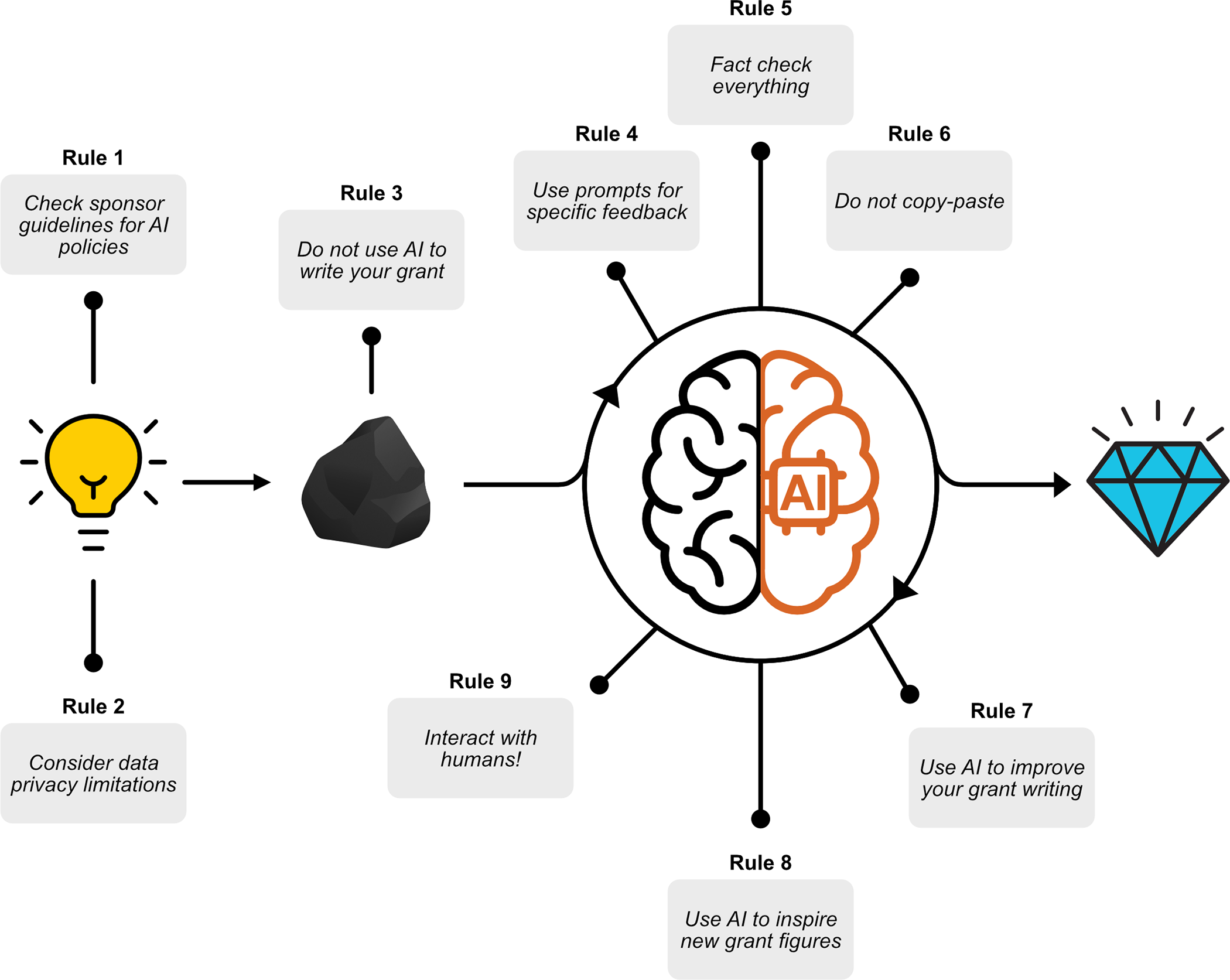
Seckel, E., Stephens, B. Y., & Rodriguez, F. (2024). Ten simple rules to leverage large language models for getting grants. PLoS Computational Biology, 20(3). https://doi.org/10.1371/journal.pcbi.1011863
Resources and Agency Guidance
Federal agencies generally allow the use of generative AI in proposal preparation, but expectations around disclosure, authorship, and responsibility are clear and continue to evolve. Below is a summary of current guidance from major sponsors, along with key takeaways for researchers. Because policies may change, we recommend reviewing the linked agency guidance for the most up-to-date requirements.
The Research Development (RD) team has also compiled a set of resources and articles outlining best practices for using AI in proposal development. Click the link below to explore these resources.
Suggested Disclosure Language
Generative artificial intelligence (AI) tools were used to assist in drafting and refining portions of the proposal text. All ideas, research concepts, methodology, and technical content were developed and validated by the authors. The authors have reviewed and verified all content and take full responsibility for the accuracy, originality, and compliance of the submission.
Guidance by Agency
National Science Foundation (NSF)
The National Science Foundation encourages transparency in the use of generative AI. If used, describe in the Project Description whether and how AI tools contributed to proposal preparation. Investigators remain responsible for the accuracy and authenticity of the submission, and research misconduct policies (fabrication, falsification, plagiarism) apply regardless of AI use.

Department of Energy (DOE)
The Department of Energy requires explicit disclosure of AI use in proposal development. If AI is used, you must describe in the Project Summary how and to what extent it contributed to the proposal. Investigators remain responsible for ensuring the work is original and does not infringe on third-party rights. Misuse of AI (e.g., fabrication, falsification, or plagiarism) may constitute research misconduct. Disclosure requirements are embedded in individual NOFOs.

National Institutes of Health (NIH)
NIH allows limited use of generative AI in proposal preparation but requires that applications reflect the original ideas of the research team. Proposals that are substantially generated by AI may be considered non-compliant. Investigators remain responsible for ensuring accuracy, originality, and integrity, and should be aware that AI use may introduce risks such as plagiarism or fabricated citations. NIH has also implemented limits on the number of submissions per PI, in part due to concerns about AI-enabled overproduction of proposals.

NASA
NASA allows the use of generative AI but requires transparency, attribution, and data protection. If used, AI must be cited in the references section, including the tool name, version, date/time, and how it was used. Non-original content must be acknowledged, and the proposal team remains responsible for accuracy and authenticity. Sensitive or controlled information should not be entered into AI tools, as prompts may be stored and reused.